

From Boston to the Mongol Steppes
When Esther Jacobson-Tepfer was a school girl in Boston she would spend hot summer days in the library reading Chinese poetry from the Tang Dynasty. Her imagination with China’s golden age was intensified by its interaction with nomadic Mongol tribes.
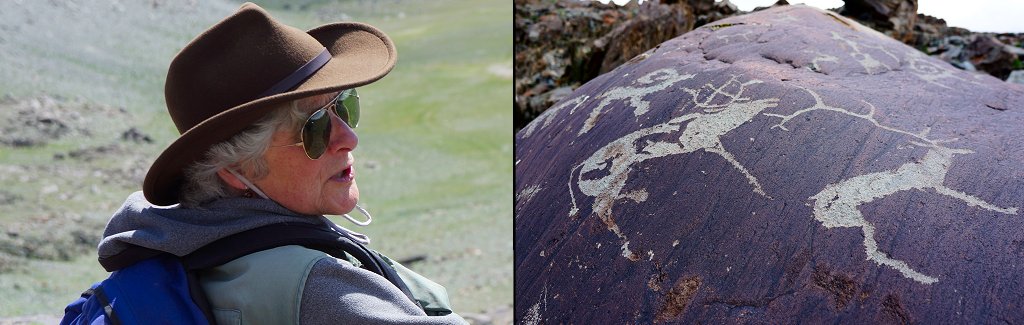
“There was nobody telling me ‘go east young lady,’ but I was enthralled with the poetry I found on those library shelves,” Jacobson-Tepfer recalls. That youthful intellectual curiosity would lead to an academic career transporting her from the air conditioned Boston library to frosty mornings camping on the petroglyph studded steppes of Mongolia’s Altai Mountains. Jacobson-Tepfer’s Mongolian archaeological discoveries led to international recognition for the Altai in June when UNESCO named the rock art complexes in this remote region wedged between the China-Russian-Kazakhstan borders a UNESCO World Heritage Site.
After spending two decades discovering and chronicling three sites in the Altai and its river valleys, Jacobson-Tepfer is eager to share her discoveries. Jacobson-Tepher and her husband, photographer Gary Tepfer, were the featured lecturers on Tusker’s “Mongolia-Altai Mountains: Ancient Culture and Photography Workshop.” It’s the first time such trip was run. These sites are rich in artistic and natural beauty and participants came in contact with the region’s sparse inhabitants where Yaks outnumber herders and petroglyphs outnumber both.
Tusker has been running horse treks into Mongolia’s Altai Tavn Bogd National Park for the last five years and Tusker owners, Eddie and Amy Frank will lead the workshop trip next summer.
Jacobson-Tepfer is a professor at the University of Oregon and Gary Tepfer is a well known photographer whose life’s works coalesced amid the thousands of rock carvings and funeral glyphs in Northwestern Mongolia. Their coffee table book “Archeology & Landscape in the Mongolian Altai: An Atlas,” was published in 2009.
“I’m a professor, I believe in education and with Eddie and Amy’s group I get the chance to teach the material to a sophisticated group who could be supportive of preservation for this area,” Jacobson-Tepfer said. “Tourism threatens the area as there have been French groups who leave filth and there have been Chinese who have come in and badly defaced some of the panels. The area’s valleys are off limits to mining but the management plan that we developed under UNESCO must be enforced.”
Jacobson’s Journey
Jacobson-Tepfer’s early career focus was China and her doctoral thesis was Chinese art history but her interest with the nomadic tribes pushed her into the Altai. From these impressive peaks and grasslands spilled the Mongols who would rule the world under Genghis Khan for a brief period. To peel back the layers of 12,000 years of history she had to overcome linguistic, political and environmental barriers.
She first went to Russia in 1966 but the cold war was raging and the U.S.’ Vietnam involvement limited her access to the archives that held documents she wanted to see that might shed some light on the nomad’s history in the period long before Genghis Khan. Borders with Russia and China were sealed; besides, there were no passable roads or flights into the region making travel to Mongolia impossible. Off the tourist map Mongolia was that big empty space she hoped to someday visit because she sensed it would contain a trove of prehistoric artwork that could add to the world’s repository of ancient knowledge.
In 1975 she received a fellowship to return to Russia and she had access to the rich trove of material in Leningrad’s Hermitage Museum. Over the next ten years she continued to teach at the University of Oregon but gradually transitioned to specializing in the art of North Asia’s nomadic tribes. In the late 1980s she attended a Mongolian Conference and made several important contacts that would help break down borders and lead to field work in the Altai region.
In 1989, Jacobson-Tepfer’s research started in the Russian Altai, and led to her first book, “The Deer-Goddess of Ancient Siberia: A Study in the Ecology of Belief.” The book’s catalyst was the many rock art depictions of a deer motif, an elegant stag with antlers. Jacobson-Tepfer’s theory was if the meaning of the deer could be clearly deciphered it would solve much of the mystery surrounding the complex art and culture of that prehistoric period.
“There were hundreds of theories of the stag image which have been rendered in gold and bronze in contemporary art. The dominant theories were that it was totemic, or it represented the male warrior or was part of a solar cult. I had a problem with all three,” Jacobson-Tepfer recalled. Her theory went against the grain and put a feminist spin on the deer’s meaning. The elegant stag was actually a goddess with antlers, a source of life. She based her theory on finding rock art with the stylized deer with birthing women.
Jacobson-Tepfer’s curiosity about the region grew larger, the closer she was able to get to the border of Mongolia, because the rock art became much richer. She sensed that once border restrictions would ease, and entry into Mongolia was possible her research would enter another realm. Her husband, Gary Tepfer, started working with her in the early 1990s and his photographic eye and mountain climbing background paid dividends in her research. Tepfer’s sense of landscape helped her see how the rock art and landscape fit together. His climbing prowess uncovered several key panels that contained important deer goddess works.
Hunters, Herders, Warriors
Finally in 1994 entry was gained to the Mongolian Altai and Jacobson-Tepfer headed a Russian-American research team that spent a decade cataloging three Mongolian sites, two of which will be included in Tusker’s trip next July. These sites include Tsagaan Salaa/Baga Oigor located along a 20-kilometer stretch of two rivers, and the mountain slopes that drain into them. There are at least 100,000 images etched into the boulders here that depict both cultural and environmental changes.
The second site, Upper Tsagaan Gol is smaller and more modern with sophisticated artwork found in funerary altars and in cemeteries. The work spans the 2nd millennia B.C. to the 9th Century. The three UNESCO sites span 12,000 years of Mongolia’s history starting when the area was partly forested, and supported hunters of big game. When the trees and big game were gone the region supported herding and finally the horse arrived and a nomadic warrior culture evolved.
Jacobson-Tepfer began lobbying for UNESCO protection in 1998 and it took much prodding within Mongolia and on the international stage before the award was made. Without Jacobson-Tepher’s efforts it’s likely it wouldn’t have happened, but she is loathe taking all the credit, deferring to her field colleagues and Mongolian officials. She is extremely glad it worked out, and now wants to share the area with Tusker’s clients.
“You get the sense of dramatic change as the environment changes with the transfer from hunting to herding. With the arrival of the horse in the Bronze Age it has a monumental impact reshaping the history of the Turkic Mongol people. There is a huge amount of information in the rock and I was driven to see this material known, understood and valued,” Jacobson-Tepfer concluded.
This is the second of a 3-part series on Tusker Trail’s unique trip with Esther Jacobson-Tepfer: “Mongolia-Altai Mountains: Ancient Culture and Photography Workshop.”